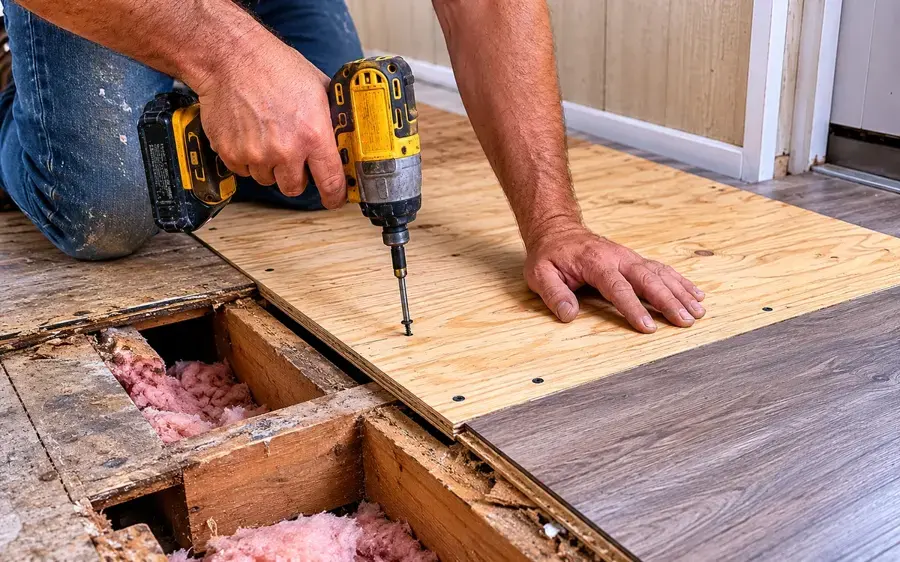
Zephyrhills has a large stock of manufactured home parks, and water damage in those homes follows a different path than in a block house on a slab. The floor sits above the ground on a frame, and the layers under it, from particleboard to insulation to the belly wrap, hold water out of sight. This post explains what to check and why drying starts from below.
Key takeaways
- A manufactured home floor is built in layers, and water that reaches the top layer can soak the particleboard subfloor and the insulation beneath it.
- A soft spot, a sag or a musty smell can show up well after the leak itself has stopped.
- Wet underbelly insulation holds water against the floor, so it is usually removed and replaced rather than dried in place.
- Drying a manufactured home often means opening the floor system from below, not only running fans on top.
- Summer storms, air conditioners and old water heaters are common sources in the Zephyrhills wet season.
How a manufactured home floor is built
A manufactured home sits on a steel frame above the ground. The floor is built from particleboard or similar board laid over joists, with insulation below and a protective wrap, often called the belly wrap, closing off the underside.
That arrangement keeps the home dry in normal conditions. When water gets in from above, though, the same layers hold it in.
Where the water comes from
Zephyrhills has a wet season from June to September with near daily afternoon thunderstorms, a hurricane season that runs from June 1 to November 30, and a long cooling season. Each of those can put water into a park home.
- Roof seams, vents and flashing that let in rain during a storm.
- An air conditioner whose condensate drain clogs and overflows.
- A water heater that leaks, especially an older tank worn down by hard groundwater.
- Supply pipes and fittings that fail under or inside the floor.
- Washer hoses, sinks and tubs that leak into the floor around them.
What water does to the layers
Water rarely stays at the surface. It moves down through carpet and vinyl into the board beneath, then into the insulation under it.
The subfloor swells and softens
Particleboard is made from wood chips and glue. When it gets wet it swells, loses strength and crumbles at the edges.
A floor that feels soft or bouncy near a wall, tub or doorway is a warning sign.
Once the board has swollen, it does not return to its original shape, so wet sections are usually cut out and replaced.
Underbelly insulation holds water
Insulation under the floor soaks up water and keeps it against the board above. It is slow to dry and can keep the floor damp for a long time after the leak has stopped.
For that reason, wet underbelly insulation is typically removed and replaced, not saved. The mobile home water damage page describes how the underbelly is checked.
Walls and the lower edge of paneling
Water that reaches the floor edge moves into the bottom of the walls. Paneling and drywall wick moisture upward, and the lower framing can stay damp behind them.
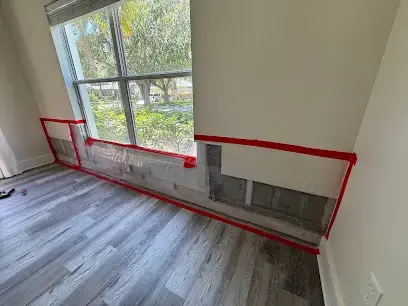
Pulling the baseboard and checking behind it with a moisture meter shows whether the wall needs to be opened as well.
What to check first
A quick inspection can show how far the water has traveled. None of it requires tools.
- Press on the floor near the leak, a tub or a doorway to feel for softness.
- Look for a sag or a ripple in the vinyl or carpet.
- Check inside cabinets and closets for dampness at the floor edge.
- Smell for a musty odor, especially in the morning before the air conditioner runs.
- Look under the home, where access allows, for a drooping belly wrap or wet insulation.
- Check ceiling stains below a roof seam or vent, since rain can travel along framing before it drips.
Why drying starts from below
Fans on top of a wet floor mostly dry the surface. The water in the particleboard and the insulation is under it, so air has to reach those layers directly.
Crews often open the belly wrap, take out wet insulation, cut away swollen board and set drying equipment so air moves through the floor system. Moisture readings show when the framing and remaining board reach the dry goal.
In the Zephyrhills wet season, outdoor humidity is high, so dehumidifiers do much of the work and the home is kept closed while the equipment runs. The structural drying page explains how that monitoring works.
- Standing water is extracted first.
- Wet insulation is removed, and the belly wrap is opened where needed.
- Swollen particleboard is cut out in sections.
- Air movers and dehumidifiers dry the framing and remaining board.
- Readings continue until the structure reaches its dry goal.
The first day after a leak
The first day matters more in a manufactured home than in many other houses, because the floor layers keep absorbing water until the source is shut off and the water is removed.
Stopping the water comes first, then protecting the floor, then calling for help with extraction and drying.
- Shut off the water at the home's main valve if a pipe or fitting is leaking.
- Turn off power to wet rooms if it can be done safely.
- Take photos of the leak, the wet floor and any stained ceiling or wall.
- Lift furniture and rugs off the wet area, but avoid walking on a soft floor more than necessary.
- Run the air conditioner on a low setting to keep humidity down, unless water has reached the unit.
Costs, parks and insurance
The price cards on the mobile home page show one room caught early at $1,500 to $3,500, replaced subfloor sections at $3,500 to $7,000, and several rooms plus the belly at $7,000 to $10,000. Those are typical ranges, not a quote.
Residents of a park should also tell management or the landlord when a leak involves shared plumbing or the structure, and then check the insurance policy before cleanup begins. Photos, dates and drying logs help with the claim.
The water extraction page covers the first step, and the roof leak page covers storm leaks from above.
Questions
Why does a manufactured home floor go soft after a leak?
The floor uses particleboard, which swells and loses strength when it gets wet. A soft spot is a sign the board has absorbed water.
Can wet underbelly insulation be dried and kept?
Usually not. Insulation under the floor holds water against the board above, so it is typically removed and replaced.
Does the whole floor have to come out?
Not always. Swollen board is cut out in sections, and the rest is dried and checked with moisture readings. The extent depends on how long the floor stayed wet.
What are common sources of leaks in park homes?
Roof seams during storms, clogged air conditioner drains, aging water heaters and failed supply fittings are all common, especially in the wet season.
Should a park resident contact the landlord or park management?
If the leak involves shared plumbing or the structure, yes. Residents should also check their own insurance policy and document the damage.